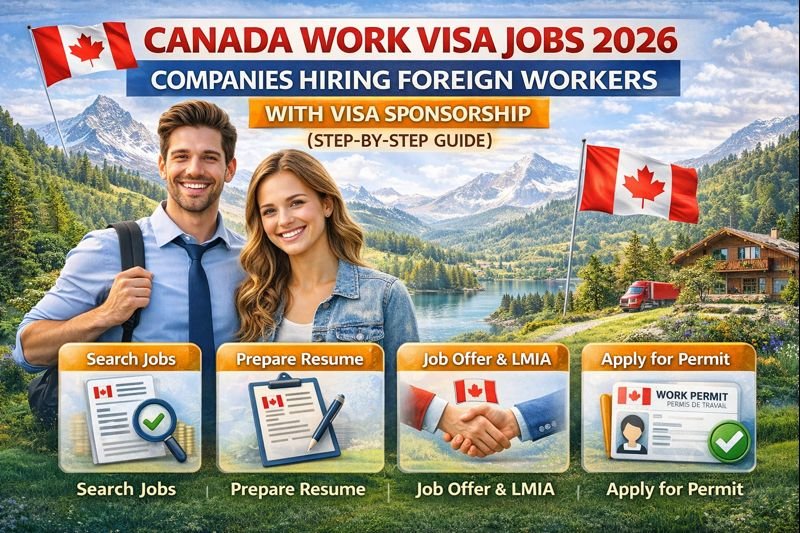
Getting a job in Canada with “visa sponsorship” usually means one of two legal routes:
-
LMIA-based hiring under the Temporary Foreign Worker Program (TFWP), where the employer applies for a Labour Market Impact Assessment (LMIA), or
-
LMIA-exempt hiring under the International Mobility Program (IMP), where the employer submits an offer of employment through the Employer Portal.
The good news: in 2026, you can find employers actively recruiting foreign workers using official Government of Canada tools, especially Job Bank’s Temporary Foreign Worker listings.
Step 1: Understand what “Visa Sponsorship” really means in Canada
In Canada, there isn’t a single document called “sponsorship for jobs.” Instead, employers help you legally by doing one of these:
-
LMIA route (TFWP): Employer applies for LMIA (Service Canada/ESDC), then you use the LMIA + job offer to apply for a work permit.
-
LMIA-exempt route (IMP): Employer submits your job offer in the Employer Portal (if required), and you apply for a work permit using that offer number.
Step 2: Pick your target job category (high demand areas)
Many foreign-worker hires fall into these common sectors:
-
Farming & agriculture (farm worker, greenhouse worker, harvest labour)
-
Food processing and production
-
Trucking & logistics (where eligible)
-
Construction trades
-
Hospitality (cook/chef, some service roles)
-
Caregiving (specific streams may apply)
Tip: choose a role that matches your real experience—Canada employers check this seriously.
Step 3: Find “companies hiring foreign workers” the smart way (official sources)
Option A: Job Bank – Temporary Foreign Workers section (Best method)
Job Bank has a dedicated area where you can search jobs from employers who have already obtained or applied for an LMIA. This is the closest thing to a “verified sponsorship job list.”
What to do:
-
Go to Job Bank and open Temporary Foreign Workers search
-
Filter by location, wage, occupation
-
Look for postings that indicate LMIA requested / LMIA applied / LMIA approved (wording may vary by posting)
Option B: Job Bank – Foreign candidates from outside Canada
Job Bank also provides a section for foreign candidates searching from outside Canada.
Option C: Open Government “Positive LMIA employers” dataset (Extra research)
Canada also publishes an open dataset related to positive LMIAs (approved LMIAs). You can use it to identify employers that have successfully used the LMIA process before.
(Use it as research only—always verify current vacancies on Job Bank or employer websites.)
Step 4: Build a Canada-style resume (simple + results-based)
Keep it 1–2 pages and include:
-
Job title + years of experience (example: “Farm Worker – 3 years”)
-
Key skills (harvesting, greenhouse work, milking, forklift, packing, etc.)
-
Work history with duties and results (numbers help)
-
Availability (full-time/seasonal, shift work)
-
Language level (basic/intermediate English)
Don’t add fake experience—this is the fastest way to get refused later.
Step 5: Apply online the right way (so employers respond)
For each job:
-
Read the full posting (duties, wage, location, accommodation info if any)
-
Click Apply (Job Bank or employer site)
-
Write a short cover note (3–5 lines). Example:
“I have 3 years of farm/greenhouse experience, can work long shifts, and can relocate. I’m available immediately and can provide references.”
Apply to 10–20 relevant jobs per week to increase chances.
Step 6: If an employer selects you, confirm the legal route (LMIA vs LMIA-exempt)
Ask politely:
-
“Will this position be supported with an LMIA or is it LMIA-exempt under IMP?”
Why it matters:
-
LMIA jobs require an LMIA document (employer side).
-
LMIA-exempt jobs often require the employer to submit an offer in the Employer Portal.
Step 7: Prepare your work permit application (documents checklist)
Common documents include:
-
Passport
-
Job offer letter / contract
-
LMIA + LMIA number (if LMIA route)
-
Employer Portal offer number (if LMIA-exempt route)
-
Proof of experience (reference letters, pay slips if available)
-
Education docs (if required)
-
Police/medical documents if requested (depends on job/country)
Always follow the official instructions in your IRCC application process.
Step 8: Avoid scams (very important)
Red flags:
-
“Pay money to get LMIA/job guarantee”
-
Fake “consultants” promising instant visa
-
Employers asking for illegal fees
Safe rule: You apply through official Job Bank/employer channels and use official government processes.
Quick Conclusion
In 2026, the most reliable way to find “visa sponsorship” jobs is to search Job Bank’s Temporary Foreign Worker listings (LMIA-linked) and apply directly to employers.
Once selected, confirm whether the employer will support you through LMIA (TFWP) or LMIA-exempt (IMP) and then apply for your work permit using the correct route.
If you tell me your target field (farm, kitchen, trucking, construction, caregiver), I’ll write a job-search keyword list + resume template + cover message for that exact category.